

In this article
A pile of Ooze cards is not automatically an Ooze deck. Some commanders want copies, some want counters, and some want creatures to die in the service of a larger board. Pick the engine first; the creature type can supply the theme afterward. That one choice will do more for your deck than ranking thirteen legends and hoping the sleeves sort themselves.
Three Ooze engines, three deck shapes
| Engine | Start here | What the 99 needs | Main cost |
|---|---|---|---|
| Copy and graveyard | The Mimeoplasm | Useful creatures in graveyards, self-mill, targets with abilities | Setup and graveyard exposure |
| Wide counters | Aeve, Progenitor Ooze | Cheap spells, token support, ways to rebuild | Five-mana spell that rewards a busy turn |
| Counter value | Slogurk or Experiment Kraj | Lands into graveyard or creatures with activated abilities | Less tribal cohesion; more precise support |
That is the practical short list. “Ooze” is a creature type, not a strategic mechanic. A tribal deck can still work, but its commander should reward the cards you actually want to draw, not merely appear in the same type-line search.
The Mimeoplasm: treat the graveyard as a shared toolbox
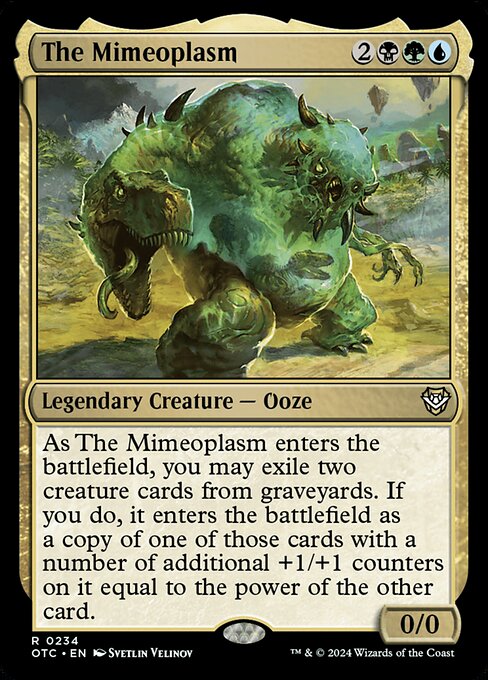
The Mimeoplasm costs {2}{B}{G}{U}. As it enters, you may exile two creature cards from graveyards. If you do, it copies one and gets additional +1/+1 counters equal to the other card’s power. Your deck therefore needs two kinds of targets: one creature whose text or body is worth copying, and another that contributes enough power to matter.
Build the graveyard deliberately. Self-mill and ordinary creature trades provide options, but do not fill the deck with expensive creatures that are embarrassing to cast and merely acceptable to reanimate. The Mimeoplasm can use an opponent’s graveyard too, so removal and combat at the table sometimes stock your toolbox for you. Sometimes the table stocks it with a 1/1. The toolbox is communal; quality control is not.
Favor cards that remain useful when drawn: a strong enters ability, evasion, protection, or a meaningful activated ability. This makes the commander a flexible finisher rather than a five-mana bet that two specific cards will be available. Keep a few ways to protect or recast it, because removal in response to the entry trigger can turn the plan into a short and unusually expensive anecdote.
Aeve: make one spell turn into a board
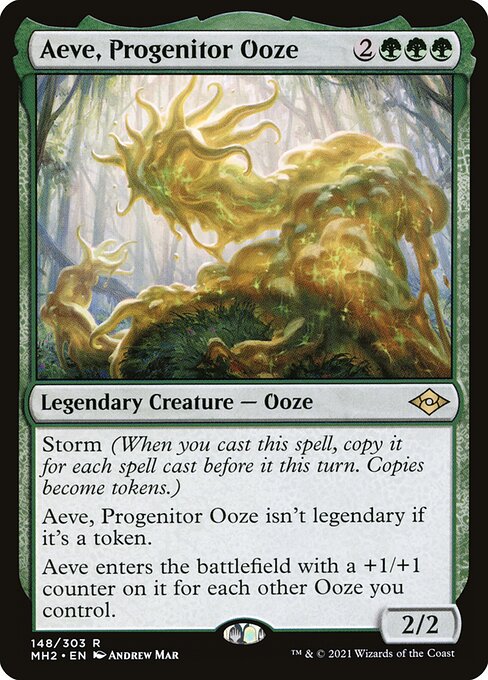
Aeve, Progenitor Ooze costs {2}{G}{G}{G}, has storm, and enters with a +1/+1 counter for each other Ooze you control. Each storm copy becomes a token, and token Aeve is not legendary. The payoff is a board, not a single enormous creature. That distinction makes counter distribution, attack support, and recovery from a sweeper more useful than another expensive Ooze.
Cheap cantrips, ramp, and instant-speed interaction let you cast several spells before Aeve. You do not need to spend a full turn doing nothing but “storm setup”; play cards that help when the commander is not in hand. Then ask whether your list can produce a worthwhile Aeve on a normal turn. If it needs seven spells, an empty stack, and the moon at the correct phase, it is a spectacle deck. Spectacle is allowed, but it should be a deliberate purchase.
Keep protection and a few ways to rebuild. Aeve’s tokens are Oozes, so the original and copies make one another larger as they enter, but a board wipe still resets the party. Avoid making every payoff depend on keeping the whole team. A modest counter subtheme works; a deck with no plan after losing twelve creatures is mostly a before-and-after photograph.
Counters without the storm count
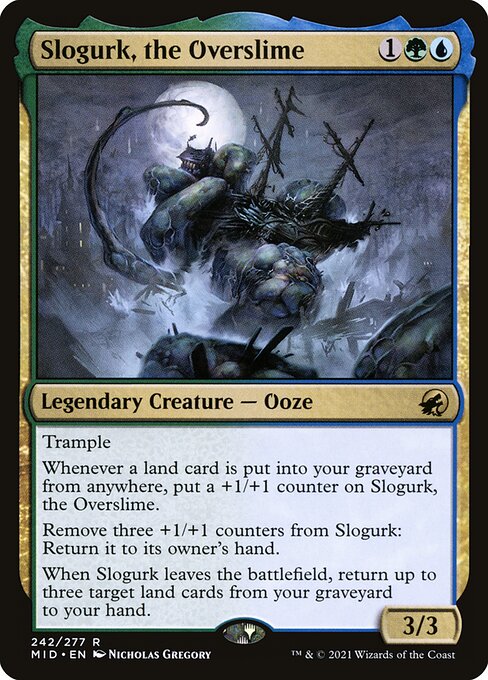
Slogurk, the Overslime costs {1}{G}{U}. It gains a +1/+1 counter whenever a land card reaches your graveyard from anywhere; removing three counters returns it to your hand, and leaving the battlefield can return up to three lands from your graveyard to your hand. That is a land-value engine with an unusually persistent commander, not a generic Ooze payoff.
Use fetch lands if available, sacrifice lands, self-mill that can hit lands, and land recursion. Do not remove counters casually: they are also the commander’s escape hatch. Slogurk can recover lands after a removal spell or its own return ability, turning a stocked graveyard into a second hand. If your list is mostly creatures and combat tricks, it will not trigger often enough to justify the slot merely because “Overslime” is an excellent word.
Experiment Kraj is the alternate counter build. It costs six mana and gains the activated abilities of other creatures with +1/+1 counters; its own tap ability puts a counter on a creature. That pushes the deck toward a toolbox: creatures whose activated abilities are worth borrowing, plus reliable ways to put counters on them. Review every proposed ability for its own costs and timing. Kraj copies the text, not the mana required to activate it, and the full board-state puzzle can become a small clerical profession.
Support cards are a deck-building constraint
Umori, the Collector asks each nonland card in your starting deck to share a card type if you choose it as a companion. As a commander, it chooses a type as it enters and reduces the cost of spells of that type by {1}. An Ooze-heavy creature list can use this discount, but the companion restriction is a different and much tighter decision. Check the entire list before treating the companion line as free value.
Other commanders point to narrower packages. Felix Five-Boots doubles certain combat-damage triggers, so it wants reliable ways for creatures to connect and useful triggers to multiply. Prime Speaker Vannifar is a creature-chain engine: her tap-and-sacrifice ability searches for a creature with mana value one higher than the sacrificed creature, but she can activate only as a sorcery and must be untapped. Either can helm an Ooze-flavored deck, but neither asks for tribal density first.
Before adding another card, label it “engine,” “enabler,” “interaction,” or “theme.” If most of the list lands in “theme,” add cards that help the commander work. If most are enablers, make sure there is a payoff. Flavor can fill a few slots; it cannot make the opening hand keepable by itself.
A note on newly previewed Oozes
Draftsim’s October 22 ranking includes recently previewed cards, including Mimeoplasm, Revered One and Mutagen Man, Living Ooze. Scryfall lists their current Oracle text and Commander legality; both are legal there. The list also mentions Uugguu, the Omniplasm and It Came from Planet Glurg, both marked not legal in Commander by Scryfall. Uugguu is listed in Mystery Booster Commander Edition (MBC) with a 2026-10-19 release date; verify its distribution and current format treatment before putting it on an event decklist. Previews and novelty cards may have different play contexts, so confirm the current card page and the format’s rules before adding them to a sanctioned list. A card being printed and a card being legal are separate facts; cardboard has always been a demanding bureaucracy.
The practical verdict
Choose The Mimeoplasm for graveyard copying, Aeve for a spell-fueled board, or Slogurk for land recursion and counter management. Choose Experiment Kraj when borrowing activated abilities is the part you want to build around. Then make the support cards do something useful without the commander. That produces a coherent Ooze deck; counting every legend with Ooze in its type line produces a decklist with a theme and a committee.
Source: Draftsim’s “All 13 Ooze Commanders in Magic Ranked” prompted this independent engine-based guide. All card text, mana costs, color identities, Commander legality and card images were checked against Scryfall on October 23, 2026.