

Infinite mana is one of the oldest Commander temptations in the book. You start by telling yourself you just want a little extra ramp, then two turns later you are explaining why your creature is technically also a land and why that means everybody is dead.
These 24 engines put the receipts beside the jokes: what must already be on the battlefield, what starts the loop, and what you actually get. The ranking is an editorial Commander preference for compact pieces and useful homes, rather than a measured tournament tier list.
Checked October 19, 2026: Names, mana costs, Oracle text, color identity and Commander legality were checked against current Scryfall card records; rules were checked against Wizards’ September 25, 2026 Comprehensive Rules and relevant Wizards rulings. Every named card in the completed lines below is Commander legal on that date. That does not make every line legal in Modern, Pioneer or Pauper, or suitable for every Commander bracket. Card links open the exact text and format information.
Here, “infinite” means repeatable for an arbitrarily large finite number of iterations. Name your number, show the sequence and give opponents their interaction windows. Unless stated otherwise, the listed pieces are already on the battlefield, you control and own anything you blink, their abilities work normally, and there are no taxes, replacement effects or other restrictions stopping the line. “Ready” means a creature can legally use a tap or untap symbol, through continuous control since your turn began or haste. Setup costs are separate from the mana needed to start repeating.
On this page: all 24 combos
Compare the requirements and output
The “extra condition” column assumes the named engine is assembled. Colorless mana is written {C}; a numeral such as {3} is a generic cost you may pay with any mana.
| Rank / engine | Extra condition to repeat | Net output |
|---|---|---|
| 24. Deathmantle / Golem | Golem can die and return | +1 mana of a chosen color per death |
| 23. Guardian / Double / Panharmonicon | Double copies Guardian; a land returns untapped | That land’s mana each blink |
| 22. Ygra / Confectioner / Altar | One expendable creature | +1 mana of any color per Rat |
| 21. Mikaeus / Belcher / Altar | Belcher has no +1/+1 counter; its ETB targets itself | +1 mana of any color per death |
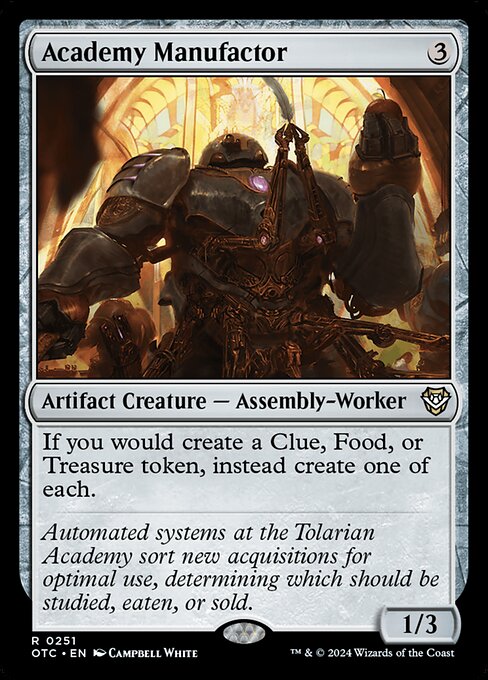
| 20. Magda / Clock / Automaton / Manufactor | Manufactor on battlefield or in library; build five tapped Treasures to tutor it | +1 untapped Treasure per tap after Manufactor |
| 19. Estrid / Chain Veil | Veil enchanted; enchanted sources make M ≥ 5; first Veil activation available | M − 4 mana per cycle |
| 18. Bounty / Reiterate | L ≥ 7 lands; 13 starting mana, including {R}{R}{R} | L − 6 Treasures per copied Bounty |
| 17. Ashaya / Ley Weaver | Ready Weaver; a second usable mana land | Second land’s mana each untap |
| 16. Dance / Worldgorger | Reusable sources returning untapped; a safe exit | Sources’ mana per return |
| 15. Guide / Altar / Reveillark | Both creatures can die and return | +{C}{C}{C}{C} per pair of sacrifices |
| 14. Rings / Basalt | Untapped Basalt; {2} seed mana | +{C} per copied untap |
| 13. Weaver / Pemmin’s Aura | Ready Weaver; X ≥ 2 enchantments, including these two cards | X − 1 blue per blue cycle; other colors with a blue reserve |
| 12. Selvala / Staff | Ready Selvala; greatest power P ≥ 6; {G} seed | P − 5 mana per cycle |
| 11. Kodama / Provisioner / Chamber | Chamber can enter once; order bounce before landfall | +1 Treasure per Chamber entry |
| 10. Navigator / Drake | Paired; up to five lands make M ≥ 3 with blue access | M − 2 mana per blink |
| 9. Rona / Amber / Helix | Ready front-face Rona; Helix resolved on her | +{U} per Amber recast |
| 8. Artist / Haze | Four earlier spells and {4} including red; or ten starting mana from storm zero | s − 3 Treasures when s spells preceded that Haze |
| 7. Hullbreaker / Ring / Bauble | Untapped Ring; Bauble in hand | +{C} per pair of casts |
| 6. Chatterfang / Plunderer | Two 1/1 Squirrels; {B} seed; the targeted Squirrel must die to -1 toughness | +1 Treasure after the next {B} payment per cycle |
| 5. Pili-Pala / Architect | Ready Pili-Pala; {U} to make it blue | +1 unrestricted mana of any color per untap |
| 4. Kinnan / Basalt | Untapped Basalt | +{C} per tap-and-untap |
| 3. Broodscale / Blade | Blade equipped; one Spawn, or {1}{G} to adapt without counters | +{C} and a +1/+1 counter per Spawn |
| 2. Dramatic Scepter | Reversal imprinted; nonland sources make M ≥ 3 | M − 2 mana per activation |
| 1. Druid / Reconfiguration | Aura attached; Druid remains a noncreature Vehicle | +{G} per untap |
24. Nim Deathmantle + Composite Golem
Starting conditions and resources: Both cards are on the battlefield. Golem is a nontoken creature you own; nothing prevents it entering from your graveyard. No extra seed mana or tap ability is required. Commander color identity: WUBRG, because Golem’s rules text contains all five colored mana symbols.

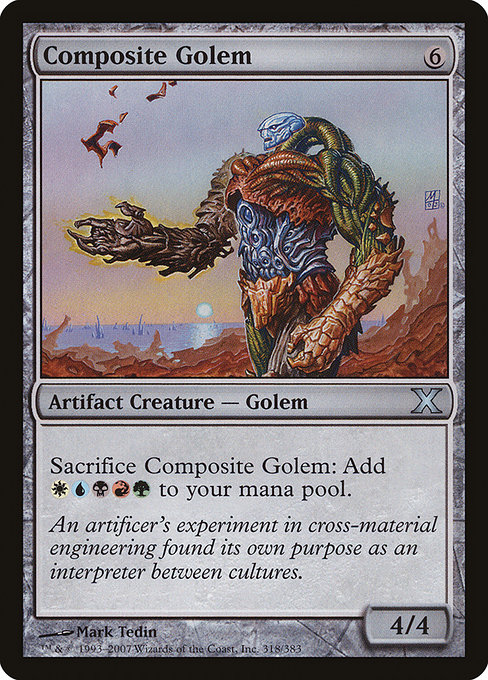
- Sacrifice Composite Golem to its own mana ability, adding {W}{U}{B}{R}{G}.
- Nim Deathmantle’s death trigger goes on the stack. When it resolves, pay {4} using four of that mana.
- Return Golem and attach Deathmantle. Keep the fifth mana and repeat.
Net mana and result: +1 mana of a color you choose to retain each loop, plus repeatable creature entries and deaths. Repeat different color choices to build your required mix. Golem is a weird ATM whose withdrawal fee is one less than the withdrawal.
Main weak point: Graveyard exile in response to Deathmantle’s trigger, removing Deathmantle before the next death, or effects that stop creatures returning. Sacrificing Golem is a mana ability; the subsequent Deathmantle trigger is an interaction window.
23. Felidar Guardian + Spark Double + Panharmonicon
Starting conditions and resources: Panharmonicon and Felidar Guardian are on the battlefield. Spark Double enters copying Guardian; you also have a land that produces mana and returns untapped, such as a basic land. No additional mana is needed after Double resolves. Commander color identity: WU.
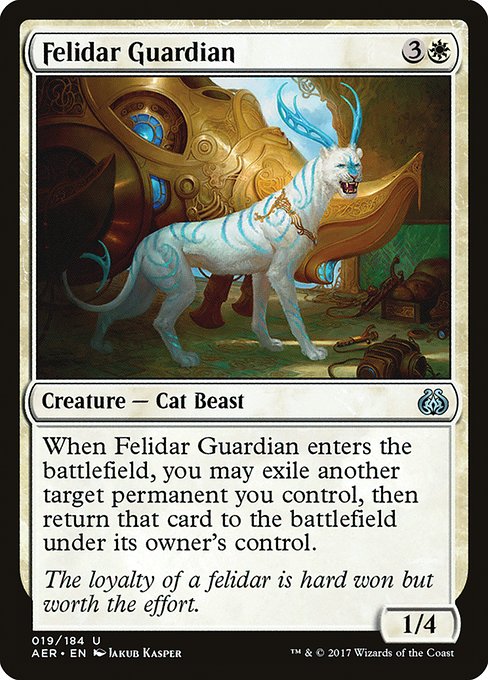
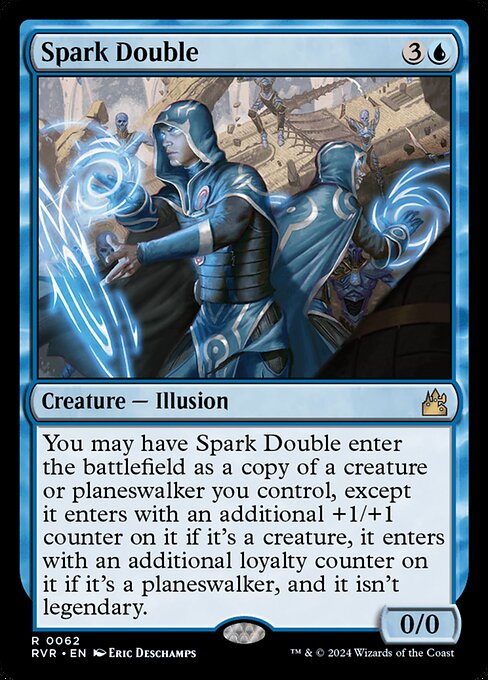
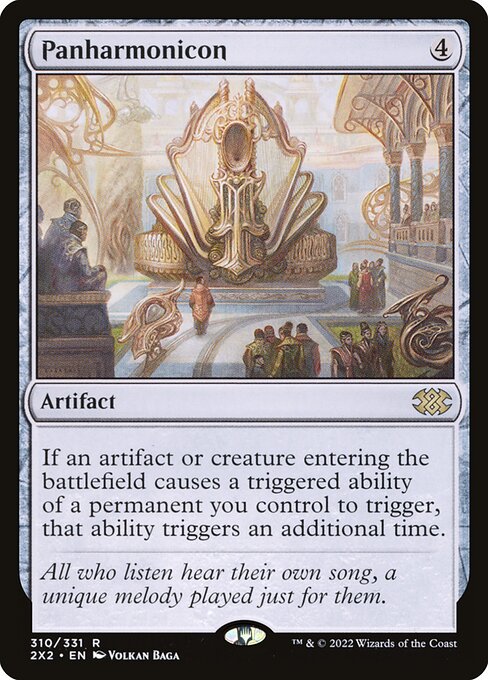
- Double’s copied Guardian ability triggers twice. Target the land with one trigger and the original Guardian with the other; put the land trigger on top.
- Tap the land before its blink trigger resolves. Blink it, returning it untapped.
- Resolve the other trigger to blink the original Guardian. Its two new triggers target the land and Spark Double, again resolving the land blink first. Tap the land for mana before that blink.
- When Double is blinked, choose to copy the original Guardian again as it returns. Repeat the alternating sequence.
Net mana and result: Each Guardian entry refreshes the land for its usual mana, with no repeat cost. You also get repeatable creature entries. This is peak blink-player behavior: stack management, suspicious cats, then an accounting problem.
Main weak point: Removing either Guardian or Panharmonicon, suppressing entry triggers, or using a land that returns tapped. Double must be able to copy a Guardian that is already present when it returns.
22. Ygra, Eater of All + Experimental Confectioner + Phyrexian Altar
Starting conditions and resources: All three pieces and one other expendable creature are on the battlefield. An existing Rat works; an ordinary Food token alone cannot be sacrificed to Phyrexian Altar because it is not a creature. Commander color identity: BG.
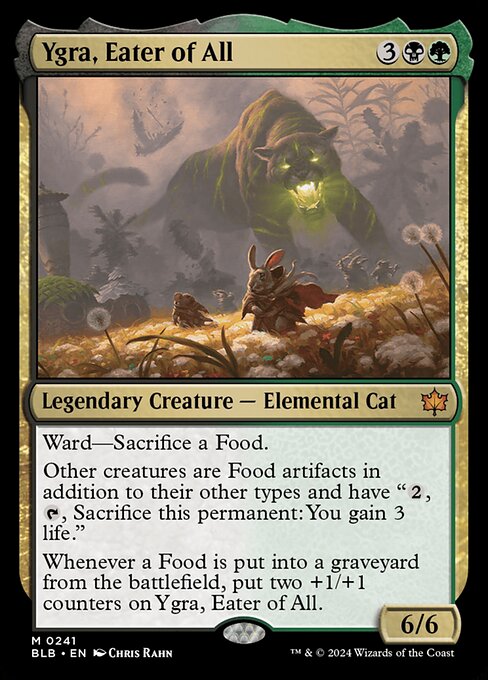

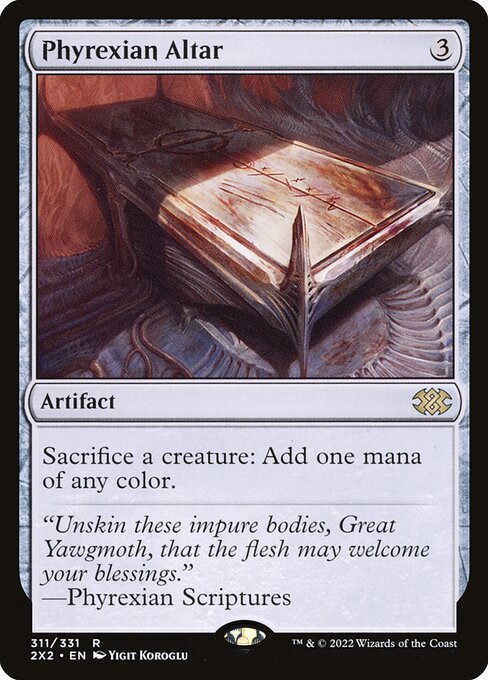
- Sacrifice the expendable creature to Phyrexian Altar for one mana of any color. Ygra makes that creature a Food as well.
- Confectioner triggers because you sacrificed a Food. Resolve it to make a Rat, which Ygra also makes a Food.
- Sacrifice that Rat to the Altar. Resolve Confectioner’s replacement Rat and repeat.
Net mana and result: +1 unrestricted mana of any color per Rat sacrificed; Ygra also gets counters from Foods dying. There is no {2} Food activation fee: the sacrifice is paid to the Altar. The snack technology wins like a spreadsheet.
Main weak point: Removing Ygra before the next Rat sacrifice means the Rat is no longer Food; removing Confectioner stops replacement bodies. Graveyard-replacement effects can also change which death-dependent benefits happen.
21. Mikaeus, the Unhallowed + Plague Belcher + Phyrexian Altar
Starting conditions and resources: All three are on the battlefield. Belcher is a non-Human and has no +1/+1 counter. Each Belcher entry trigger must target Belcher itself; let that trigger resolve before sacrificing again. Commander color identity: B.
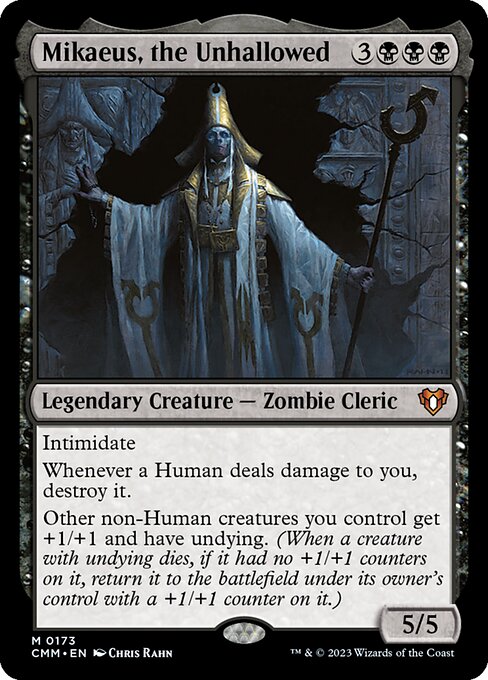
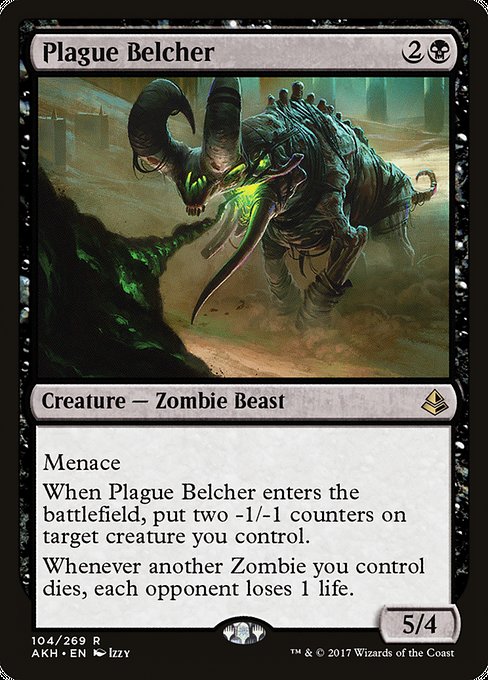
- Sacrifice Belcher to the Altar for one mana of any color. Undying triggers because it had no +1/+1 counter.
- Return Belcher with a +1/+1 counter. Its entry trigger puts two -1/-1 counters on itself.
- State-based actions cancel one +1/+1 counter against one -1/-1 counter, leaving one -1/-1 counter and no +1/+1 counter. Belcher survives with Mikaeus’s static boost.
- Sacrifice it again and repeat the same reset.
Net mana and result: +1 mana of any color and a repeatable Belcher death/entry each cycle. Belcher does not drain opponents for its own death: its ability says another Zombie. Add a separate death payoff if you want the loop to win without spending the mana.
Main weak point: Exiling Belcher in response to undying, removing Mikaeus, or leaving an extra +1/+1 counter on Belcher when it dies. Mikaeus’s +1/+1 static bonus is not a counter.
20. Magda + Clock of Omens + Universal Automaton, with Academy Manufactor
Starting conditions and resources: Magda, an untapped Clock and an untapped Automaton are on the battlefield. Academy Manufactor must be on the battlefield or available in your library for Magda to find. Automaton is an artifact Dwarf through changeling. No haste is required: Clock’s cost tells you to tap artifacts rather than using Automaton’s own tap symbol. Commander color identity: R.
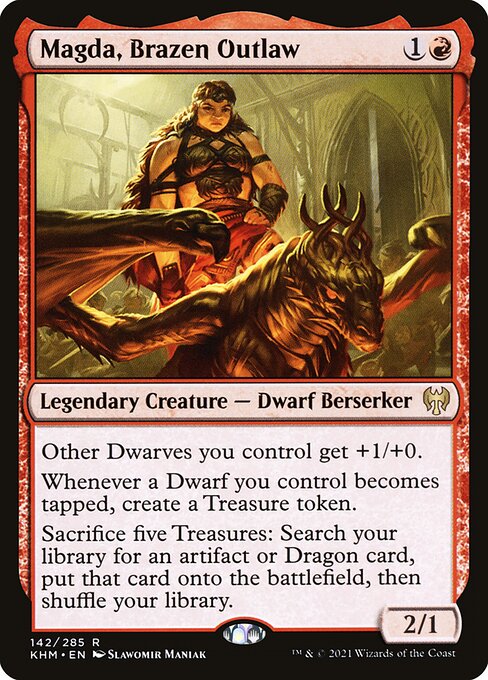

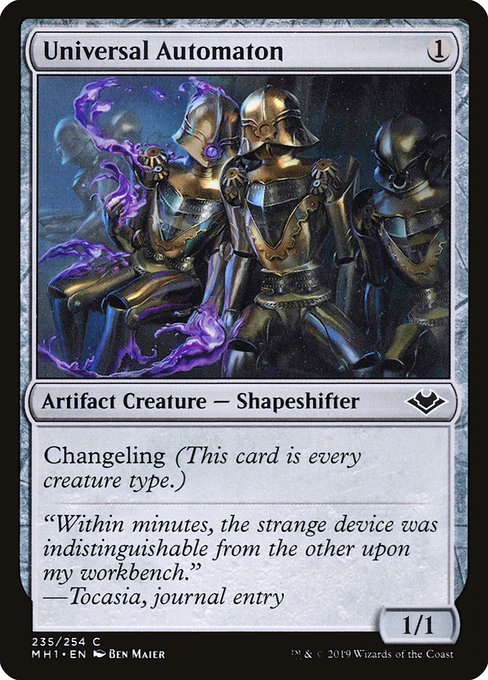
- Without Manufactor, tap Automaton and Clock to pay Clock’s cost, targeting Automaton. Magda triggers; resolve the trigger to create an untapped Treasure, then resolve Clock to untap Automaton.
- Repeat by tapping Automaton and the newest untapped Treasure. Each time Magda makes the next Treasure and Clock untaps Automaton. Continue until you have at least five tapped Treasures, retaining the newest untapped one.
- Sacrifice five tapped Treasures to Magda’s tutor ability and put Academy Manufactor onto the battlefield. Tapped Treasures can pay this sacrifice cost.
- Tap Automaton and the retained untapped Treasure to Clock. With Manufactor, Magda’s trigger now creates a Clue, a Food and a Treasure. Untap Automaton.
- Thereafter tap Automaton and the newest Food to Clock. Each trigger replaces that Food and adds another Clue and an untapped Treasure.
Net mana and result: After Manufactor joins, +1 untapped Treasure per repeat, convertible to any color, plus Clues and tapped Foods. The initial three cards alone accumulate tapped Treasures, not an arbitrarily large pool of immediately spendable mana. The tutor supplies the missing converter. Changeling is secretly a genre of nonsense, but tap symbols still matter.
Main weak point: Removing Magda or the artifact Dwarf, stopping artifact activations, or preventing the library search before Manufactor arrives. If Manufactor is unavailable, describe the three-card result accurately rather than promising infinite mana.
19. Estrid, the Masked + The Chain Veil
Starting conditions and resources: The Chain Veil is enchanted, usually by an Estrid Mask made earlier. Enchanted mana sources you can legally tap produce a combined M ≥ 5 mana. Veil is untapped and you can pay its first {4} activation. Work in your main phase with an empty stack for each loyalty activation. Commander color identity: GWU.

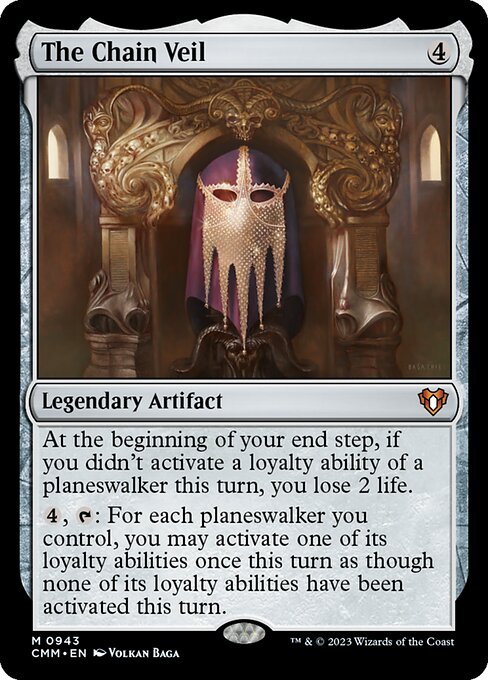
- Tap the enchanted sources for M mana and spend {4}, tapping Chain Veil. Resolve its ability.
- Use an available activation of Estrid’s +2 to untap the enchanted mana sources and the enchanted Veil.
- Repeat. Every resolved Veil activation grants another loyalty activation, so repeatedly choosing +2 keeps the engine supplied.
Net mana and result: M − 4 mana per cycle, using the colors your sources provide, plus two loyalty on Estrid per +2. At exactly four mana the untap loop is mana-neutral, rather than positive. A tasteful cardigan has become a power plant.
Main weak point: Removing Veil’s Aura means Estrid no longer untaps it; removing a mana Aura may drop production below the threshold. Do not use Estrid’s -1 to make the Mask and assume it also untaps Veil: the Mask setup and the first {4} payment need to be available.
18. Brass’s Bounty + Reiterate
Starting conditions and resources: You control L ≥ 7 lands, have both spells in hand, and can pay 13 mana including at least {R}{R}{R}: {6}{R} for Bounty and {1}{R}{R} plus {3} buyback for Reiterate. That is the ordinary-cost startup, before any reducers. Commander color identity: R.
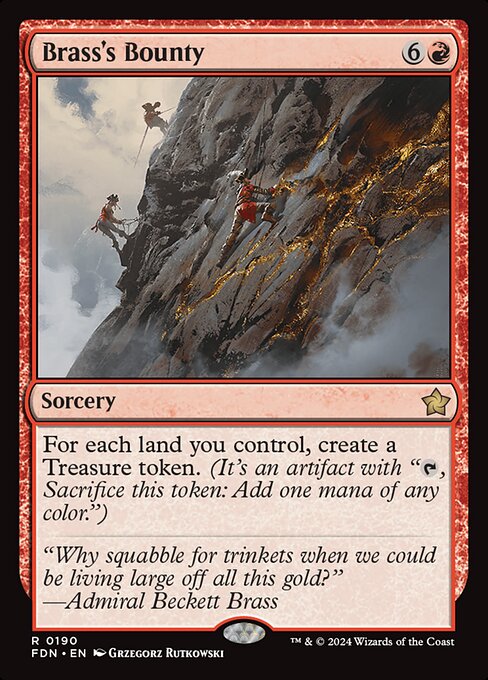
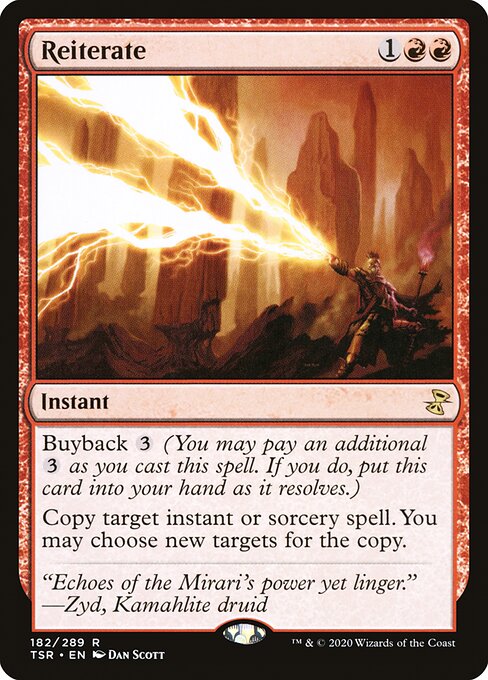
- Cast Brass’s Bounty. Keep the original on the stack.
- Cast Reiterate targeting Bounty, paying buyback for a total of six mana.
- Resolve Reiterate: create a Bounty copy and return Reiterate to hand. Resolve the copy to make L Treasures, while leaving the original Bounty unresolved.
- Spend six Treasures, including two for red, to cast Reiterate with buyback targeting the original again. Repeat.
Net mana and result: L − 6 Treasures per repetition. Seven lands means +1; six only breaks even. Cash the surplus into any colors when needed. Buyback keeps Reiterate coming home like it forgot its lunchbox.
Main weak point: Countering the original Bounty removes the repeatable target; countering Reiterate stops its normal buyback return. Losing lands can also erase the positive margin.
17. Ashaya, Soul of the Wild + Ley Weaver
Starting conditions and resources: Ashaya and a ready, untapped Ley Weaver are on the battlefield, plus another usable mana-producing land. If that second land is an Ashaya-made creature land, it must also be ready to use its tap ability. Commander color identity: G.

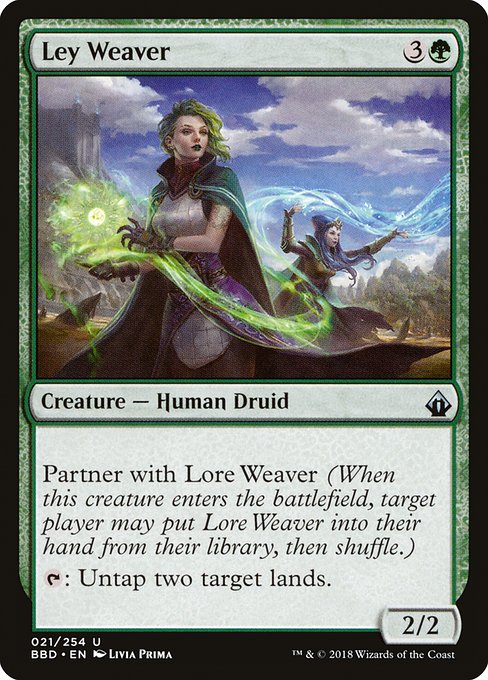
- Tap the second land for its mana.
- Tap Ley Weaver to untap two target lands: Weaver itself, which Ashaya makes a Forest land, and the second land.
- Resolve the untap ability and repeat.
Net mana and result: The second land’s full output per cycle, with no mana cost. A basic Forest means +{G}. Other colors require a land that actually produces them. Ashaya’s board states remain high on “please read that static ability again.”
Main weak point: Removing Ashaya breaks Weaver’s ability to target itself as a land; summoning sickness prevents a newly cast Weaver starting the line without haste.
16. Dance of the Dead + Worldgorger Dragon
Starting conditions and resources: Dragon is in a graveyard and you can cast Dance for {1}{B}. Your battlefield includes reusable mana sources, typically lands, that return untapped. Have a safe exit: another creature card Dance can legally enchant in a graveyard, or an instant-speed way to stop the loop after banking mana. For the simple exit below, use a creature without a similar forced reanimation loop or protection from black. Commander color identity: BR.

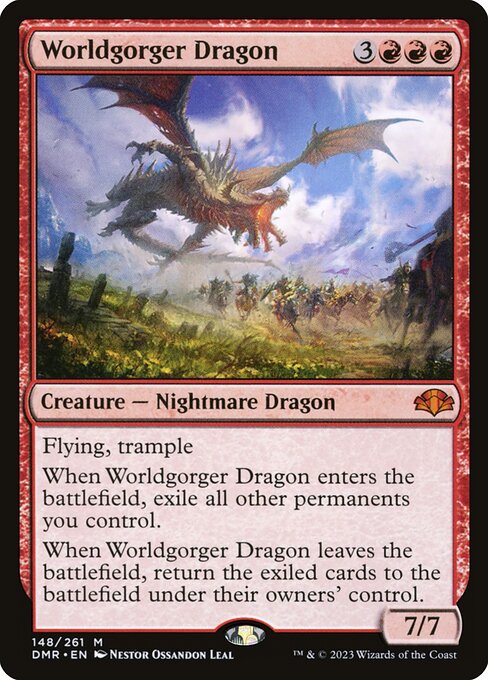
- Cast Dance targeting Dragon. Its entry ability returns Dragon tapped and attaches Dance.
- With Dragon’s entry trigger on the stack, tap your mana sources. Resolve that trigger to exile your other permanents, including Dance.
- Dance leaving causes Dragon to be sacrificed. Dragon’s leave trigger returns the exiled permanents, including the lands and Dance.
- Choose Dragon in the graveyard for the returning Dance to enchant. Its entry ability returns Dragon and the sequence repeats. Tap the refreshed lands before each Dragon entry trigger resolves.
- After the chosen number of cycles, return Dance attached to the other legal creature card instead. Let it return that creature, ending the Dragon loop with your mana available.
Net mana and result: Your returning sources’ output per cycle; colors depend on those sources. Your other permanents also repeatedly leave and enter. Without a valid way to stop a mandatory loop, the game can be drawn. This is reanimator jazz: the exit is part of the sheet music.
Main weak point: Dragon removal before its initial exile trigger resolves can leave your other permanents exiled indefinitely. Graveyard interaction and enchantment removal also matter. Do not begin this line with “I’ll find an exit later” as the entire plan.
15. Karmic Guide + Ashnod’s Altar + Reveillark
Starting conditions and resources: All three pieces are on the battlefield. Guide’s power in the graveyard is 2 or less, and both creatures can return from the graveyard. No seed mana or haste is required. Commander color identity: W.

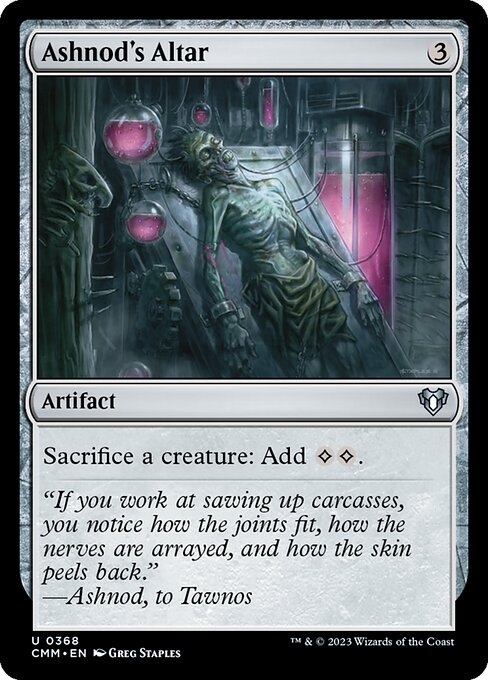

- Sacrifice Karmic Guide to the Altar for {C}{C}.
- Sacrifice Reveillark for another {C}{C}. Its leave trigger targets Guide in your graveyard.
- Return Guide. Its entry trigger targets Reveillark; return Reveillark.
- Both creatures are back. Repeat.
Net mana and result: +{C}{C}{C}{C} per full pair of sacrifices, plus repeatable entries, leaves and deaths. Reveillark returns Guide; Guide returns the normally four-power Reveillark. Keeping those jobs straight saves a judge call. The trigger pile is still catnip for white graveyard decks.
Main weak point: Graveyard exile in response to either return trigger, stopping entry triggers, or effects that stop creature cards entering from a graveyard.
14. Rings of Brighthearth + Basalt Monolith
Starting conditions and resources: Both artifacts are on the battlefield, Basalt is untapped, and you have {2} from outside the initial Basalt activation to seed Rings’ payment. Commander color identity: colorless.
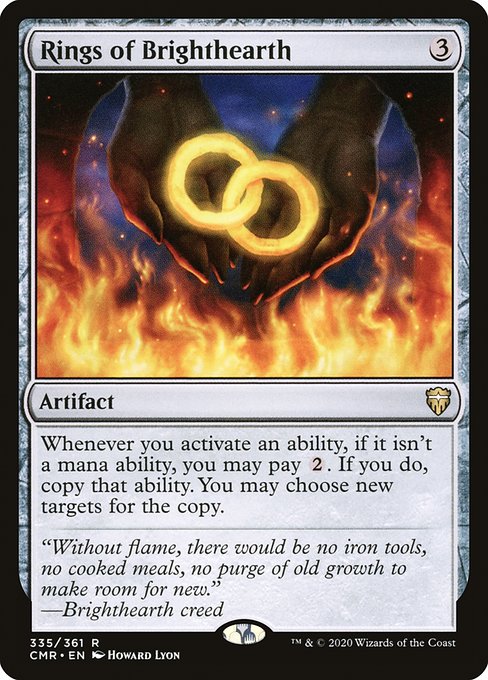
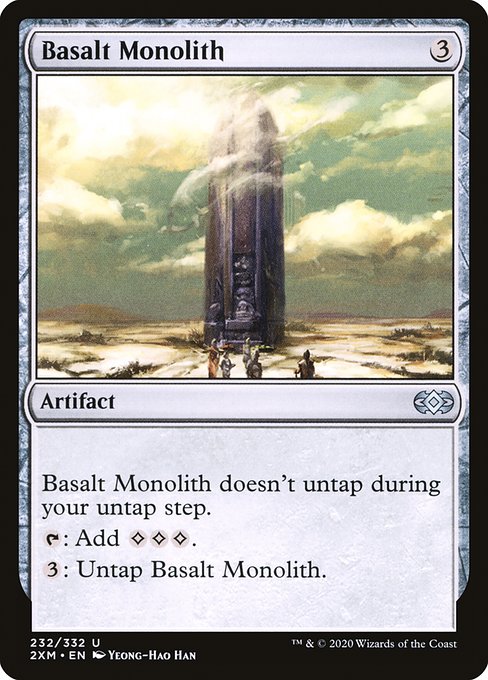
- Tap Basalt for {C}{C}{C}, then spend that three mana activating its untap ability.
- Rings triggers because the untap ability is not a mana ability. Pay {2} to copy it.
- Resolve the copied untap. Tap Basalt for another {C}{C}{C} while the original untap is still on the stack.
- Resolve the original untap. Basalt is untapped again with three mana floating. Repeat, paying the next Rings fee from your growing reserve.
Net mana and result: +{C} per full cycle: three generated against two spent on Rings, after Basalt funds its own {3} untap. The initial two-mana reserve is essential. Your artifact deck has moved from ramping to “please stop asking how much floating mana I have.”
Main weak point: Artifact removal or an activation shutdown. Resolve the copied untap separately and tap Basalt before the original resolves; resolving both without that tap loses the profit.
13. Sanctum Weaver + Pemmin’s Aura
Starting conditions and resources: Ready, untapped Weaver is enchanted by Pemmin’s Aura. You control X ≥ 2 enchantments; these two cards already count, because Sanctum Weaver is an enchantment creature. Commander color identity: GU.


- Tap Weaver for X blue mana.
- Spend {U} on the Aura’s untap ability. Resolve it and repeat, retaining X − 1 blue per cycle.
- To make other colors, first build a blue reserve. Then tap Weaver for the desired color and pay the {U} untap cost from that reserve. Repeat enough blue cycles to cover the number of other-color activations you need.
Net mana and result: At the minimum X = 2, each blue cycle nets {U}; with that reserve you can generate arbitrarily large amounts of any chosen color. “Two green, spend one to untap” does not work without blue available. Enchantress players may still insist this was a fair value deck five minutes ago.
Main weak point: Creature or Aura removal, ability suppression, and Weaver’s summoning sickness. The Aura’s shroud ability can protect Weaver after attachment, but costs additional blue and cannot prevent every kind of interaction.
12. Selvala, Heart of the Wilds + Staff of Domination
Starting conditions and resources: Ready, untapped Selvala and untapped Staff are on the battlefield. The greatest power among creatures you control is P ≥ 6, and you have {G} to start Selvala’s activation. The high-power creature is a real extra requirement. Commander color identity: G.


- Pay {G} and tap Selvala to add P mana in any combination of colors. Include green for the next iteration.
- Pay {3} and tap Staff to untap Selvala.
- Pay {1} to untap Staff. Repeat from the same board state.
Net mana and result: P − 5 mana per cycle: one for Selvala, three for Staff’s creature untap, one for Staff’s own untap. Power six nets one; power five only restores the starting resources. Once you have a large reserve, Staff can also draw cards for six mana per draw including its untap, or gain life for three mana per life.
Main weak point: Removing or shrinking the greatest-power creature drops production; removing Staff or Selvala ends the engine. Count the green activation fee before declaring your permanents personally overqualified.
11. Kodama of the East Tree + Tireless Provisioner + Simic Growth Chamber
Starting conditions and resources: Kodama and Provisioner are on the battlefield. Chamber is in hand and can enter once, normally through an available land play. No mana or untapped Chamber is needed for the repeating landfall line. Commander color identity: GU.

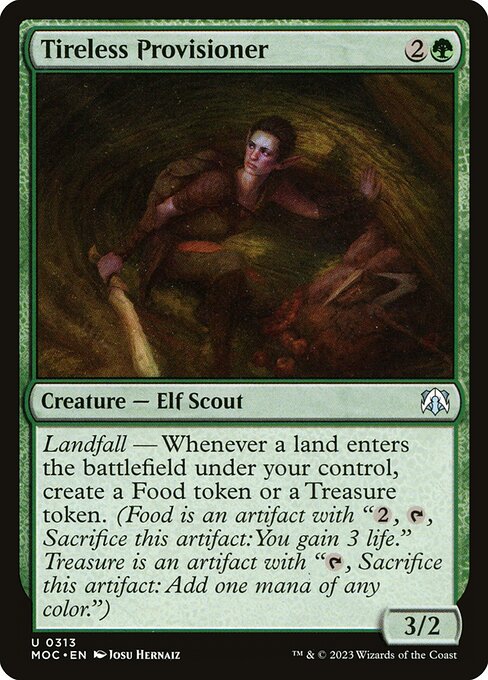
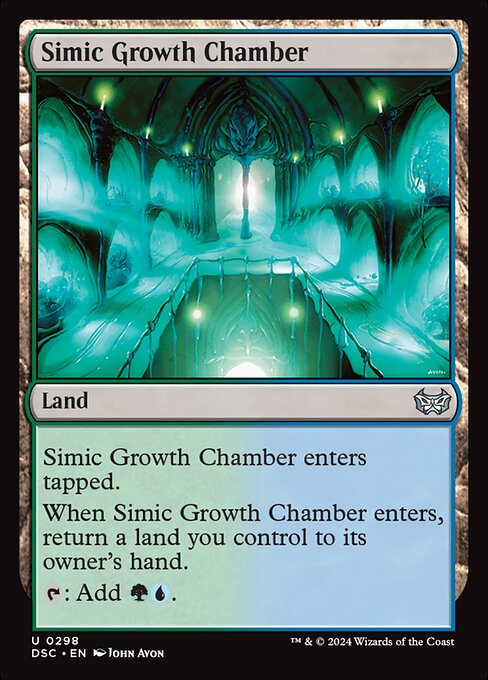
- Play Chamber. Order your triggers so its return-a-land trigger resolves before Provisioner’s landfall trigger. Return Chamber itself to your hand.
- Resolve Provisioner and choose Treasure. The Treasure entering triggers Kodama.
- Resolve that Kodama trigger to put Chamber from your hand onto the battlefield: both the token’s mana value and the land card’s mana value are zero.
- This Chamber was put in by Kodama, so its own entry does not trigger Kodama. It still triggers Provisioner and its bounce ability. Again bounce Chamber before making the next Treasure, then use that Treasure’s new Kodama trigger to return Chamber.
Net mana and result: +1 Treasure per Chamber entry, giving any-color mana and repeatable landfall. The original Chamber’s separate Kodama trigger can be declined when you finish. The land returning tapped is irrelevant because you are harvesting Provisioner’s Treasures.
Main weak point: Removing either creature, preventing landfall triggers or changing the trigger order so Chamber is not in hand when the relevant Kodama trigger resolves. A land drop still feels like a felony, but it needs paperwork.
10. Deadeye Navigator + Peregrine Drake
Starting conditions and resources: Navigator is soulbond-paired with Drake. Up to five lands you can untap together produce M ≥ 3 mana, with enough blue to pay {1}{U} each iteration. You can pay the first {1}{U}, including by tapping those lands. Commander color identity: U.
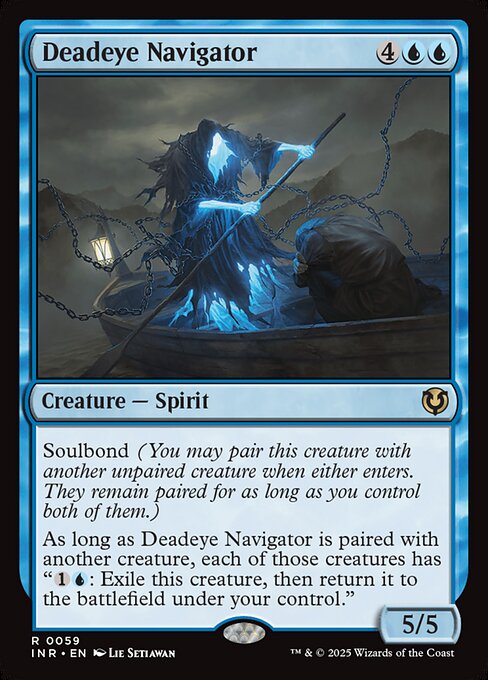

- Tap the relevant lands, retaining their mana.
- Pay {1}{U} to activate Drake’s granted ability, exiling and returning Drake.
- Resolve Drake’s land-untap trigger and Navigator’s soulbond trigger, pairing the two again.
- With the lands refreshed and the pair restored, repeat.
Net mana and result: M − 2 mana per blink. Three one-mana lands, including an Island, net one mana if you assign colors carefully; five such lands net three. Output colors come from your lands. The combo has elder status, but “untap five” still means five lands you actually have.
Main weak point: Removal while soulbond is waiting to resolve, entry-trigger suppression, or lands that cannot cover the blue fee. Drake temporarily loses the granted blink ability while the creatures are unpaired.
9. Rona, Herald of Invasion + Mox Amber + Retraction Helix
Starting conditions and resources: Ready, untransformed Rona and untapped Mox Amber are on the battlefield. Cast Retraction Helix for {U} targeting Rona and let it resolve. Use her Herald face: the transformed face does not have the legendary-spell untap ability. Commander color identity: UB.
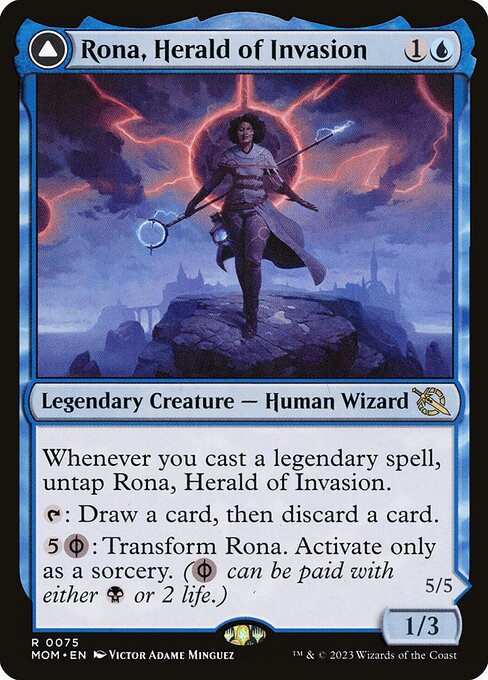
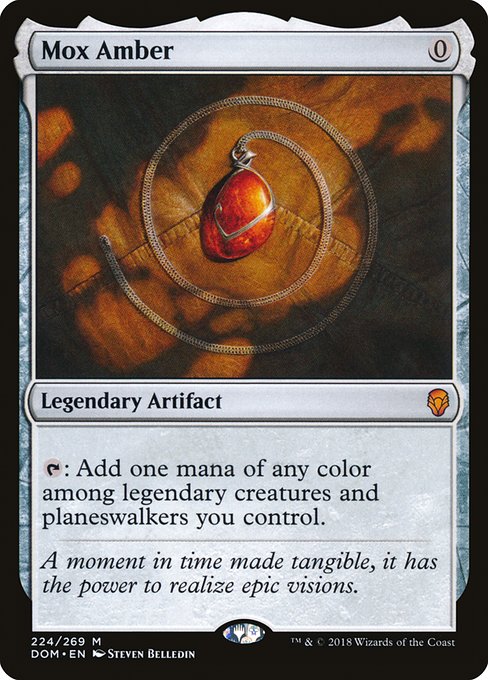
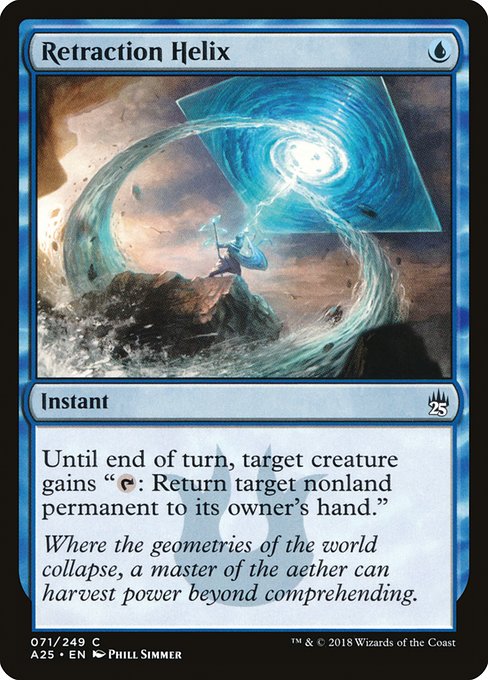
- Tap Amber for {U}; front-face Rona is a blue legendary creature.
- Tap Rona using the Helix-granted ability to return Amber to your hand.
- Cast Amber for {0}. Rona’s legendary-spell trigger untaps her; let that trigger and Amber resolve.
- Amber returns untapped, Rona is untapped, and Helix’s granted ability lasts until end of turn. Repeat.
Net mana and result: +{U} per Amber recast, plus repeated spell casts and artifact entries. Another legendary creature or planeswalker may let Amber make another color; Rona’s black color identity alone does not make the untransformed blue Rona black. Her own tap symbol means she needs haste or a turn under your control.
Main weak point: Creature removal, a counterspell on Amber, or a limit on spells cast per turn. Do not transform Rona mid-demonstration and expect the same machine to keep running.
8. Storm-Kiln Artist + Haze of Rage
Starting conditions and resources: Artist is on the battlefield; Haze is in hand. For an immediately positive cycle, at least four spells were cast earlier this turn, and you have four mana including red. Alternatively, with no earlier spells, ten available mana including red covers the initial deficits until the loop becomes positive. Cast Haze during your main phase. Commander color identity: R.

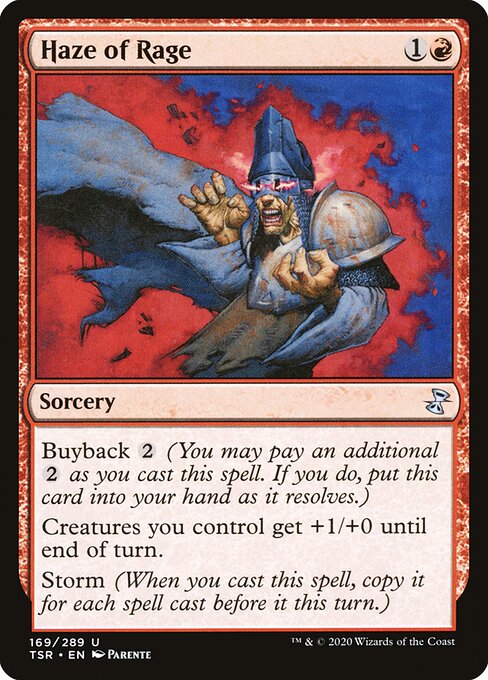
- Cast Haze with its {2} buyback, for a total cost of {3}{R}. Artist triggers for the cast.
- Haze’s storm ability creates one copy for each spell cast before this Haze. Artist also triggers for each copy.
- Resolve those Artist triggers to create Treasures, then resolve the Haze spells. Buyback returns the original Haze to your hand.
- Spend four mana, including red, on the next Haze with buyback. Each original Haze cast increases the next storm count by one.
Net mana and result: If s spells preceded this cast, you get s + 1 Treasures for four mana: net s − 3. Four earlier spells means +1 immediately. Starting at zero, the first three casts lose three, two and one mana; the fourth breaks even and later casts profit, explaining the ten-mana seed. Storm copies are not cast and do not themselves increase storm count. You also build a very large power boost, rather than automatically dealing damage.
Main weak point: Removing Artist or countering the original Haze interrupts the repeat; without resolution the original does not return through buyback. This weather event needs a real forecast, not just the word “storm.”
7. Hullbreaker Horror + Sol Ring + Mishra’s Bauble
Starting conditions and resources: Horror and untapped Sol Ring are on the battlefield, and Bauble is in hand. No extra mana is needed once this state is assembled. Do not sacrifice Bauble for its own draw ability. Commander color identity: U.


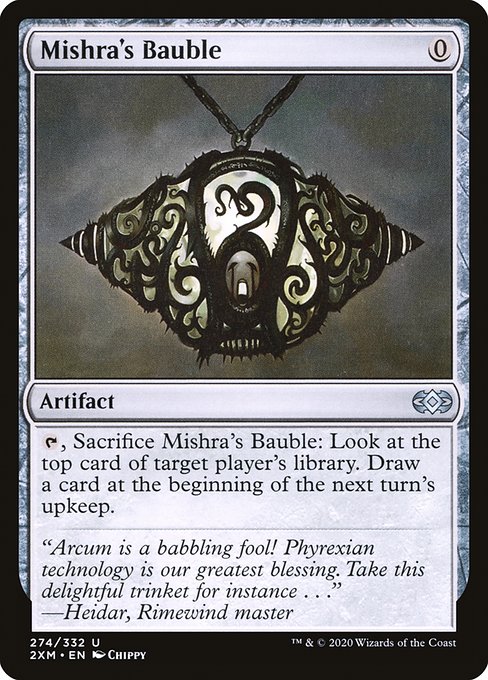
- Tap Ring for {C}{C}. Cast Bauble for {0}; use Horror’s cast trigger to return Ring to your hand. Let Bauble resolve.
- Spend {1} to cast Ring; use Horror’s trigger to return Bauble to your hand. Let Ring resolve.
- You are back at the starting state, with one colorless mana left over. Repeat.
Net mana and result: +{C} per pair of artifact casts, plus repeated casts and artifact entries. This exact engine produces colorless mana; different mana artifacts change the arithmetic and colors. Horror has turned every cast into a boomerang and the mana total into an espresso habit.
Main weak point: Removing Horror, countering a recycled artifact, stopping artifact activations or restricting the number of spells you may cast. Horror’s own “can’t be countered” text does not protect Ring or Bauble.
6. Chatterfang, Squirrel General + Pitiless Plunderer
Starting conditions and resources: Both pieces and two ordinary 1/1 Squirrel tokens are on the battlefield, with {B} available to start. The Squirrels must be able to die: a toughness boost or an effect stopping their death changes this sequence. Commander color identity: BG.
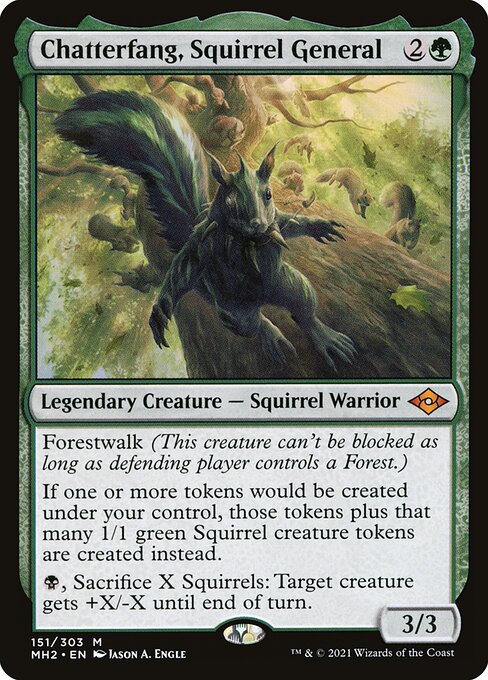
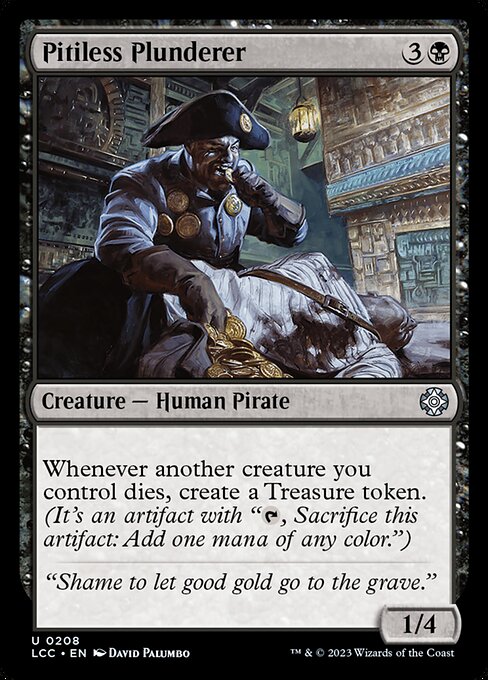
- Pay {B} and sacrifice one Squirrel to Chatterfang’s ability with X = 1, targeting the other Squirrel.
- Resolve Plunderer’s trigger from the sacrificed Squirrel. Chatterfang replaces its Treasure creation with a Treasure plus a new 1/1 Squirrel.
- Resolve Chatterfang’s ability. The targeted Squirrel gets +1/-1, has zero toughness and dies. Its Plunderer trigger makes another Treasure plus another Squirrel.
- You again have two 1/1 Squirrels, now with two Treasures. Spend one Treasure for the next {B} payment and repeat, banking the other.
Net mana and result: Two Treasures are created per cycle and one funds the next activation: +1 Treasure, convertible to any color, plus repeatable Squirrel deaths and entries. The sacrifice and the target’s later death are separate events; counting both is what makes this positive. This is half aristocrats engine, half woodland infestation.
Main weak point: Removing either piece, making the targeted Squirrel survive -1 toughness, or losing the second Squirrel stops this exact line. With only one Squirrel sacrificed and no second death, the single replacement Treasure merely refunds {B}. A free outlet such as Ashnod’s Altar is an alternative if your deck wants a version that does not rely on targeting a second Squirrel.
5. Pili-Pala + Grand Architect
Starting conditions and resources: Both creatures are on the battlefield. Pili-Pala is ready to use its untap-symbol ability, and you have {U} to activate Architect’s color-changing ability targeting Pili-Pala. Let it become blue until end of turn. Commander color identity: U.


- Tap the now-blue Pili-Pala to pay Grand Architect’s mana ability cost, adding {C}{C} restricted to artifact spells or artifact abilities.
- Spend that {2} on Pili-Pala’s own ability, untapping it as the cost and adding one mana of any color.
- Pili-Pala is untapped and still blue. Repeat.
Net mana and result: +1 unrestricted mana of any color each loop, not only blue. Architect’s restricted mana may pay for Pili-Pala’s ability because Pili-Pala is an artifact. The output is a fresh mana ability’s output and has no copied spending restriction.
Main weak point: Removing either creature or suppressing their abilities. Architect can tap a newly controlled blue creature for its own cost, but Pili-Pala still needs to legally use {Q}; haste or waiting a turn is essential.
4. Kinnan, Bonder Prodigy + Basalt Monolith
Starting conditions and resources: Kinnan and untapped Basalt are on the battlefield. No seed mana, creature tap ability or haste is required. Commander color identity: GU.
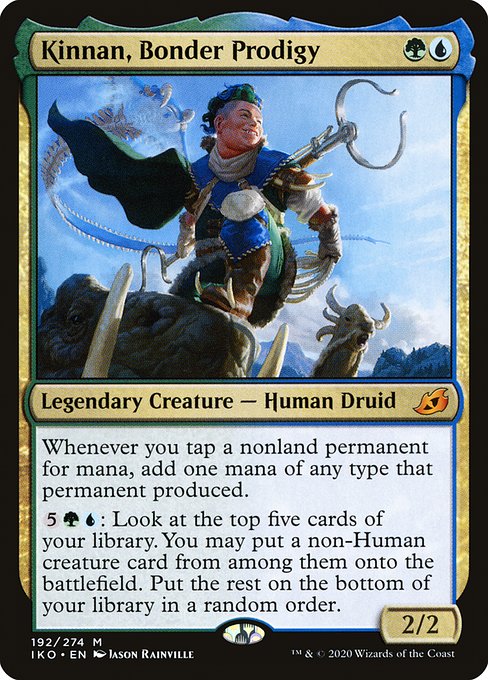
- Tap Basalt for {C}{C}{C}. Kinnan’s triggered mana ability adds another {C}, because you tapped a nonland permanent for mana.
- Pay {3} to untap Basalt, retaining {C}.
- Repeat from the same untapped board state.
Net mana and result: +{C} per cycle. Both cards fit a deck already interested in mana artifacts, which makes this a compact way to produce disrespectful quantities of colorless mana. Kinnan’s own {5}{G}{U} ability still needs green and blue from elsewhere; infinite colorless does not pay those symbols.
Main weak point: Removing Kinnan leaves Basalt generating only enough to pay its own untap; artifact activation shutdown also stops the loop.
3. Basking Broodscale + Blade of the Bloodchief
Starting conditions and resources: Blade is equipped to Broodscale. You have an Eldrazi Spawn to sacrifice, or Broodscale has no +1/+1 counters and you can pay {1}{G} to adapt once, making the initial Spawn. Blade’s equip {1} is part of the prior setup. Commander color identity: G; devoid does not remove the green symbol from its identity.


- If necessary, adapt Broodscale and resolve its counter trigger to make a 0/1 Eldrazi Spawn.
- Sacrifice the Spawn to its own ability, adding {C}.
- Blade triggers from the creature dying and puts a +1/+1 counter on Broodscale. Broodscale’s counter trigger creates a replacement Spawn.
- Repeat from the replacement Spawn.
Net mana and result: +{C} and one +1/+1 counter on Broodscale per sacrifice, with repeated Spawn entries and deaths. The token is a Spawn, not a Scion. A huge creature still needs a way to connect if you want combat to be the payoff.
Main weak point: Removing or unequipping Blade, removing Broodscale, or preventing the relevant deaths or token creation. Already having a +1/+1 counter means adapt will not supply the initial Spawn; you then need another seed death or counter effect.
2. Dramatic Reversal + Isochron Scepter
Starting conditions and resources: Scepter has exiled Dramatic Reversal through its imprint ability. Ready nonland mana sources produce a total of M ≥ 3 mana, and you can activate the untapped Scepter for {2}. Mana creatures must be ready to tap; lands do not count toward the repeatable untap budget. Commander color identity: U, plus any colors required by your chosen mana sources.

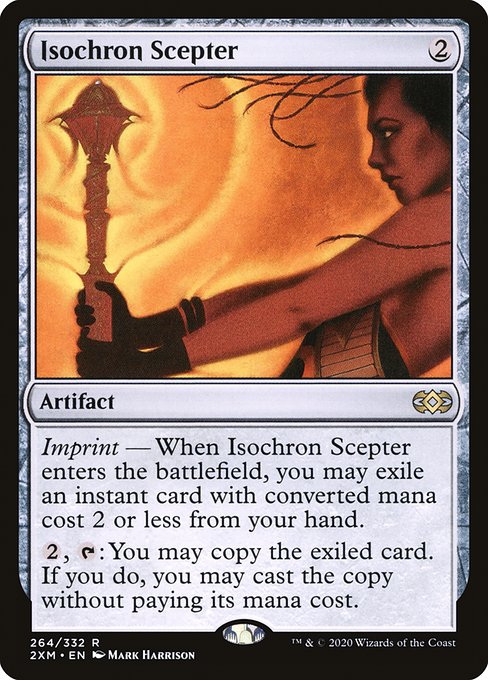
- Tap your nonland mana sources for M mana.
- Pay {2} and tap Scepter. Resolve its ability, copying and casting the exiled Reversal.
- Resolve Reversal to untap Scepter and the nonland mana sources.
- Repeat, retaining M − 2 mana each cycle.
Net mana and result: M − 2 mana per activation, in the colors your sources can leave over after paying the generic fee, plus repeated spell casts. Exactly two mana of production is a mana-neutral untap engine; it is not infinite mana. Scepter does not need a fresh {U} per activation because the copy is cast without its mana cost.
Main weak point: Removing Scepter or enough mana production, countering a Reversal copy, or limiting spell casts. The sinking feeling when someone asks whether the Scepter activation resolves remains optional table etiquette.
1. Devoted Druid + Swift Reconfiguration
Starting conditions and resources: Swift Reconfiguration has resolved attached to Druid. Druid is an untapped, noncreature Vehicle; do not crew it or otherwise animate it during the loop. No haste or extra mana is required once the Aura is attached. Commander color identity: GW.


- Tap the Vehicle Druid for {G}. Swift changes its types but keeps its abilities.
- Put a -1/-1 counter on it to pay Druid’s untap ability. Resolve that ability.
- Repeat. The counters remain, but a noncreature permanent does not die for having zero or less toughness.
Net mana and result: +{G} per tap-and-untap. Because Druid is not a creature, the creature summoning-sickness restriction does not stop its tap ability even if you cast it this turn. You have turned an Elf into a battery-powered Vehicle; the counter pile is the maintenance log.
Main weak point: Removing the Aura or making Druid a creature again lets its accumulated -1/-1 counters become a serious toughness problem, usually killing it. Artifact and enchantment interaction both matter once the conversion is complete.
How to turn the mana into a win
Make this choice before adding a combo package. A colorless engine and a hand full of colored X spells can produce a very long turn followed by a very short explanation.
- Walking Ballista: A clean colorless outlet. Cast it with a chosen large X and remove counters for damage. If it is already on the battlefield, each {4} adds another counter. Check that damage is actually able to finish the opponents you face.
- Urza, Lord High Artificer: Repeated {5} activations exile cards for play that turn. They permit playing the cards, rather than automatically casting the whole deck; normal land-play limits and other restrictions still apply. You need an actual finishing line among those cards.
- Torment of Hailfire: Needs {B}{B} in addition to X. Choose a sufficiently large finite X for the opponents’ life, hands and permanents. Its lose-life/sacrifice/discard choices and defensive effects mean “I made mana” is not itself a resolved win.
- Retrofitter Foundry: Repeated {2}, tap to make a Servo and {3} to untap gives a Servo per five colorless mana. It is a repeatable token outlet, not immediate damage; newly made creatures normally wait to attack.
Which engine belongs in your deck?
For an artifact deck with no colored commander requirement, compare Rings/Basalt’s two-mana seed with the larger Hullbreaker shell. In a green creature deck, compare the extra cards or waiting turn needed by your preferred engine: Selvala wants six power, Weaver wants to be ready, and converted Druid wants its Aura to survive. In a graveyard deck, ask whether your tutors and protection already support Golem or the Guide/Reveillark chain.
Count the support permanents, colored startup mana and finisher as part of the package. The three names printed in a heading are not always the whole shopping list. A low-opportunity-cost combo uses cards your deck already has jobs for; adding several otherwise unhelpful pieces needs a more deliberate plan.
The best infinite mana combos are the ones that do not force your deck to become a pile of embarrassing air. Keep the humor, show the arithmetic, and make sure your chosen outlet spends the mana you actually produce. If you are going to go infinite, at least do it with some style.
Sources and verification
Card faces link to Scryfall for current Oracle text, mana cost, type line, color identity, rulings and format legality, checked October 19, 2026. Wizards-origin rulings were also checked for The Chain Veil, Spark Double, Worldgorger Dragon, Dance of the Dead, Mikaeus, Grand Architect, Pili-Pala, Haze of Rage and Swift Reconfiguration. The official banned and restricted list was checked for Commander; the line involving Broodscale is not a Pauper recommendation.
Rules reference: Wizards’ Comprehensive Rules, effective September 25, 2026, especially 302.6 (tap/untap restrictions), 303.4f (Auras returning without being cast), 400.7 (zone changes), 605 (mana abilities), 606 (loyalty timing), 702.93 (undying), 704.5f and 704.5q (toughness and opposing counters), and 732 (shortcuts and mandatory loops). Mana normally empties between steps and phases under rule 106.4; plan to spend floating mana before then.
The original combo selection and countdown order were informed by Draftsim’s infinite-mana article. The conditions, step sequences, arithmetic and deckbuilding comparisons above were independently worked through from the card text and rules. They are rules analysis, not a claim of physical playtesting or a guarantee that opponents cannot interact.