
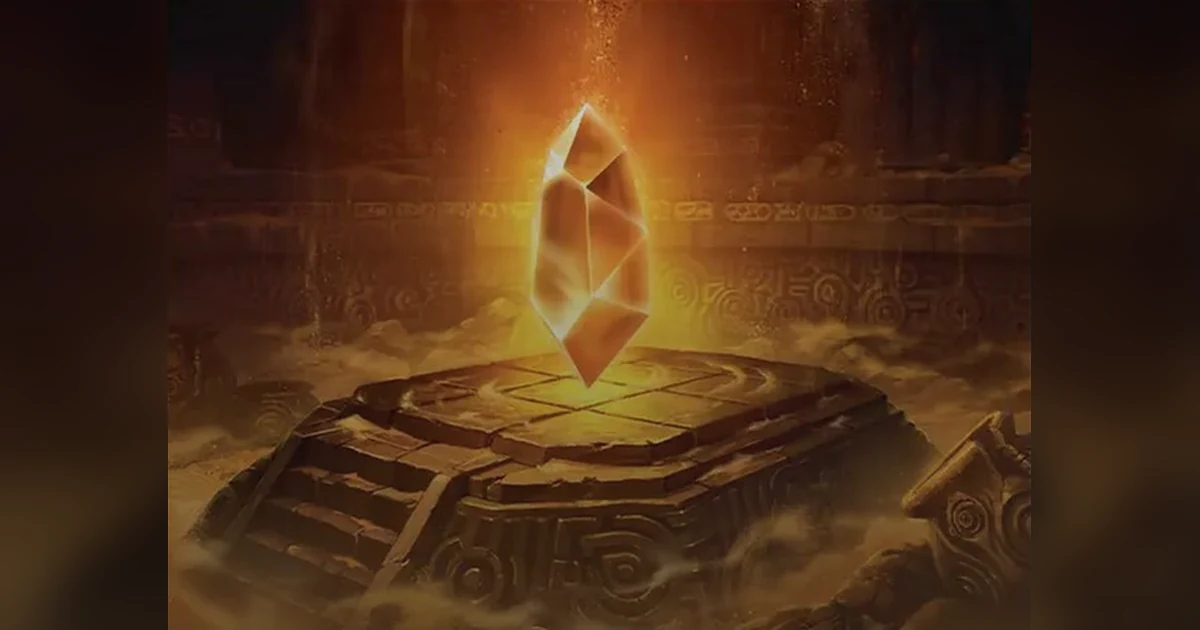
The five Final Fantasy Crystals look like mana reducers with a second job stapled on. That second job is the reason to play them. Each costs four mana, asks for two colored pips, and mostly does nothing the turn it arrives unless you already have the right board or game plan. In Commander, that can still be a bargain: the question is whether the passive text and eventual mana sink solve a real problem in your deck. Here is how to decide which Crystal belongs in a list, when to deploy it, and when to leave the shiny rock in the binder.
Start with the bill, not the bonus
Every Crystal costs {2}{C}{C} and reduces the cost of spells of its color by {1}. That is a narrower version of a familiar cost reducer: it discounts only one color, and it asks for two colored mana to come down. The discount begins paying you back only as you cast matching spells. If your deck is three or four colors and plays a modest number of that color’s spells, a four-mana artifact can spend a long time being an expensive promise.
Count the colored spells it can discount and ask how many you realistically cast after it resolves. One discounted spell is rarely enough; repeated savings can be excellent when the Crystal’s other ability also advances your plan. Mana reduction matters most when it changes a turn: casting a threat plus interaction, double-spelling sooner, or keeping up protection after a payoff.
The activation costs {4}{C}{C} and requires tapping the artifact. In other words, the card is a six-mana investment before it produces its headline effect. You usually should not cast it on turn four just because four mana is available. Do so when the passive ability is already relevant, when your next turns can exploit the discount, or when your board is stable enough to spend a turn on setup. Commander games offer time, but opponents are not legally required to admire your setup.
Choose the Crystal that changes your deck’s texture
The Earth Crystal: the cleanest board-growth engine
The Earth Crystal doubles +1/+1 counters placed on your creatures and can distribute two counters among one or two target creatures for six mana and a tap. That makes the activation useful with even one creature: put both counters on it and turn an ordinary attacker into a meaningful threat. With two targets, it can widen a board or help two creatures survive combat. The passive ability is the real engine, though. It scales counters from your other cards, so it belongs in a counter deck with enough independent counter sources to matter.
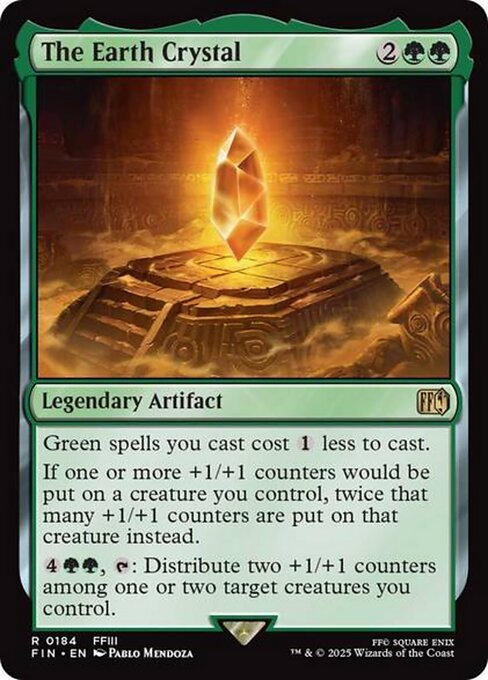
It is not a replacement for those sources. If the Crystal is the only card that cares about counters, the doubling text is decorative, and six mana for two counters is a poor use of a turn. In a green counters shell it amplifies routine plays and gives spare mana a useful outlet.
The Darkness Crystal: removal that leaves a receipt
The Darkness Crystal reduces black spells, exiles nontoken creatures an opponent controls instead of letting them die, and gains you two life when that replacement happens. Its activated ability returns a creature card exiled with it to the battlefield under your control, tapped and with two additional +1/+1 counters. This creates a strong incentive in black decks that expect creatures to die: interaction can become graveyard denial, life gain, and future reanimation value all at once.

The creature must be exiled by this Crystal’s replacement effect to be a target for its activation; it cannot take any creature from any graveyard. The replacement also denies death triggers, useful against aristocrats and awkward when your plan relies on an opponent’s creature dying. Targeted disruption, not a universal upgrade to removal.
The Fire Crystal: haste with a temporary copy
The Fire Crystal gives your creatures haste and can make a token copy of a creature you control, sacrificed at the beginning of the next end step. Haste means the card has an immediate passive impact: a creature cast later can attack or use a tap ability without waiting a turn. The copy ability becomes compelling when your best creature has a useful enters-the-battlefield trigger, an attack trigger, or a combat effect. It can also turn an unblocked attacker into extra damage for the turn.

A temporary copy is not lasting board development, and six mana is a substantial fee. Include Fire when haste is broadly valuable and you have repeatable copy targets, not because one bomb creature could make it exciting once.
The Wind Crystal: a combat finisher for life-gain decks
The Wind Crystal doubles life you would gain and, for six mana, gives your creatures flying and lifelink until end of turn. That can swing a crowded battlefield: flying makes a board evasive, while lifelink can turn one large attack into a major life swing. Its passive ability supports a dedicated life-gain plan, but the finisher is useful even when the deck’s life total is not its main project.
Board size is the test. Several creatures facing ground defenses can end a race quickly; one small creature cannot. Wind neither builds nor protects your board, so pair it with creature development instead of treating it as a standalone win condition.
The Water Crystal: for decks that actually mill
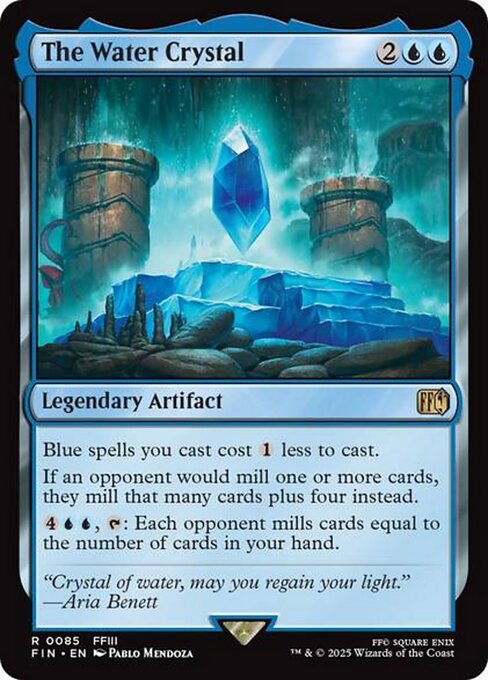
The Water Crystal discounts blue spells and adds four cards to an opponent’s mill whenever an opponent would mill one or more cards. Its six-mana activation mills each opponent for a number of cards equal to the cards in your hand. That final clause makes hand size part of the payoff: draw cards first, then activate. In a mill deck, the passive amplifier works with other mill effects, while the activation gives you a repeatable route to threaten multiple libraries.
Outside that plan, the passive text may do nothing and the activation is slow. Milling cards is not progress toward victory unless the deck can exploit or repeat it. Water is a synergy piece, not a blue value artifact that mentions libraries.
Three checks before the Crystal hits your deck
First, count the colored spells. A four-mana reducer that discounts one spell every few turns is not ramp in any useful deck-building sense. Make sure enough of your curve shares its color to repay the slot.
Second, value the passive text on its own. If the board state makes the six-mana activation impossible or unwise, does the Crystal still help? Earth doubles counters, Darkness changes removal, and Fire grants haste without activation. Water and Wind need more specific supporting strategies to affect the game passively.
Third, compare it to a cheaper role-player. If your list needs ramp, a lower-cost mana rock can help you reach four mana in the first place. If it needs an answer, a removal spell works without asking you to untap with an artifact. The Crystal earns its space when the discount and its unique effect both matter over a typical game, not when one impressive ceiling is doing all the arguing.
These are not five automatic Commander staples. They are focused engines with a substantial setup cost and a useful mana sink. Pick the one that reinforces a plan your deck already executes: Earth for counters, Darkness for removal and creature theft, Fire for haste and temporary copies, Wind for life gain and evasive combat, Water for mill. If the plan is not in the deck, a crystal is mostly a four-mana way to tell your opponents what you wish you were drawing.
Source: Draftsim’s “All 5 Final Fantasy Crystals in Magic Ranked” prompted this guide. Card details and images were verified with Scryfall. Wizards’ Final Fantasy release notes were consulted for official set context.